BIO-IMAGE ANALYST RESEARCHER

BioImage Analyst for scientific imaging platform

IBMC/i3S, Porto, Portugal


The IBMC – Instituto de Biologia Molecular e Celular is opening of an international selection tender for 1 vacancy of doctorate to perform duties of scientific research in the scientific area of Bio-Imaging, under a work contract with non-fixed term, in order to develop research activities on bio-image analysis at the i3S Advanced Light Microscopy scientific platform . The researcher should collaborate with the platform’s users by providing training and support to solve their problems of image analysis. Additionally, should collaborate in the organization of postgraduate courses in the area. Other functions may include mentoring master and doctoral students.


Admission requirements are:

General:

PhD Degree in engineering, mathematics, computer science, physics, biosciences or similar.

Specific:

– experience in digital image processing, analysis and quantification;

– experience with scientific image analysis open source software packages including ImageJ / Fiji;

– experience with programming languages: Matlab, Python, R or Java;

– experience in the design, construction and implementation of workflows for image analysis;

– knowledge of statistical analysis

– previous experience with biological or medical imaging is desirable.


More informations at: https://www.ibmc.up.pt/sites/default/files/bioimage_analyst_roteiro_paula_sampaio.pdf


For informal inquiries, please contact:

sampaio@ibmc.up.pt


Candidates shall submit their application from the 15th January 2018 to 10th February 2018 to: http://www.ibmc.up.pt/gestaocandidaturas/index.php?codigo=ROTEIRO1802


BioImage Analyst

BioImage Analyst

The Friedrich Miescher Institute for Biomedical Research (FMI) is an international biomedical research center with approximately 350 members. It is affiliated with the University of Basel and supported by the Novartis Research Foundation. We exploit a wide range of technologies to explore molecular mechanisms underlying biomedical processes in health and disease. Supporting the FMI scientists in their research are a number of outstanding technology platforms, including the Facility for Advanced Imaging and Microscopy (FAIM), which has a full-time position available immediately for an experienced and self-motivated BioImage Analyst.

IN THIS POSITION YOU WILL

  • program cutting-edge image processing plugins and scripts (Matlab, Python and ImageJ) to help FMI researchers to answer their biological questions.
  • collaborate with our Machine-/Deep-Learning specialist and Big Data systems administrator, as well as with other in-house programmers to setup workflows for big data processing.
  • teach and help users with image processing using solutions developed in house as well as commercial packages (Imaris, Arivis, Huygens, ImageJ, Neurolucida, Amira) on a day-to-day basis.
  • report to the facility managers.

 FOR THIS CHALLENGING POSITION YOU POSSESS

  • a Ph.D. or equivalent experience in biology or computer/engineering sciences, with several years of experience in image processing of fluorescence and electron microscopy images in biology.
  • very good knowledge of different image processing software, image-processing methods and programming languages (Matlab is mandatory; Python is a “plus”).
  • excellent communication and teaching skills, the desire to work as a team member, and fluency in English.

Have we raised your interest? If you would like to join a dynamic research institute, we look forward to receiving your application. Please submit your application and documents including three names for references by January 31, 2018 at

www.fmi.ch/opening.

For informal inquiries, please contact
laurent.gelman@fmi.ch or christel.genoud@fmi.ch.

Friedrich Miescher Institute for Biomedical Research
Basel, Switzerland
www.fmi.ch

Machine Learning Developer

Machine Learning Developer

Cytomine, Liege, Belgium

A full-time position R&D in Machine Learning Image Analysis.

 Cytomine : the company : http://cytomine.coop
We develop and maintain the Open Source software Cytomine, and actively collaborate with academic researchers in Machine Learning Image Analysis.
We are a young start-up, a spin-off of the University of Liege, and a cooperative open to participative governance.

 Cytomine : the software : http://cytomine.org
The Cytomine software is a full web open source platform dedicated to online collaborative analysis of very big images. It has been developped mainly for biomedical images analysis, but can be used in many other imaging fields.

 Job Summary :
You will contribute to the development of new Machine Learning Image Analysis processes and algorithms, and their integration into the Cytomine software.
You will be responsible for the quality control of new and existing processes and algorithms and will be in front-line of exciting innovations.
As we intensively collaborate with academic researchers involved in Machine Learning, you will also be responsible for the integration of new algorithms, processes or technologies issued from academic research into Cytomine.

 Responsibilities :
Participate in projects from requirements analysis to quality assurance.
Develop and improve Machine Learning & Image Analysis processes and algorithms for the Cytomine software.
Remain at the cutting edge by keeping a technology/algorithm watch into these domains in collaboration with our research community.
Customize (fine-tuning of parameters) processes and algorithms for specific customers.
Actively participate in team meetings as an actor of innovation within the company.
Keep focus on software quality (tests, documentation, …).

 Qualifications :
A Master degree in any topic related with Computer Science, Data Science or Artificial Intelligence. A PhD is an asset.
Experience in artificial intelligence applied to images. Experience and/or knowledge in Medical Informatics, Bio-engineering/Biomedical Sciences or equivalent is an advantage.

 Requirements :
Experience in Machine Learning, image analysis and processing of big data.
Experience in Python development, and especially with the Scikit-Learn library.
Able to work openly by sharing information and knowledge.
Fluent English.
Working knowledge of Linux.
Being passionate, enthusiastic, and motivated to be a self-starter.
Able to multi-task and to stay organized in a dynamic work environment.
Share the values of Open Source, Open Access, Open Science and Open Governance.

 Assets :
Knowledge in microscopy and bioimaging techniques and technologies.
Experience with Cytomine, Icy, and Bioformat softwares.
Experience in Open Source software development.
Experience with Docker.
Experience in software architecture and web development.

 What we offer :
Salary : an attractive package.
Governance : possibility to participate in the decisions of the company.
Human values : working in a social purpose company.

 Interrested ?
Contact us us at jobs@cytomine.coop

Original announcement at http://www.cytomine.coop/job


Postdoc in deep learning for medical image analysis

Postdoc in deep learning for medical image analysis

KTH Royal Institute of Technology, School of Computer Science and Communication, Stockholm, Sweden

KTH Royal Institute of Technology in Stockholm has grown to become one of Europe’s leading technical and engineering universities, as well as a key centre of intellectual talent and innovation. We are Sweden’s largest technical research and learning institution and home to students, researchers and faculty from around the world. Our research and education covers a wide area including natural sciences and all branches of engineering, as well as in architecture, industrial management, urban planning, history and philosophy.

For information about the School of Computer Science and Communication, please visit https://www.kth.se/en/csc.

Department information

The position will be formally placed with the department for Computational Science and Technology (CST) at KTH, but work will be carried out at the Science for Life Laboratory. The CST department conducts research to understand and model physical and biological systems using computational techniques, which require efficient, high performance algorithms and implementations together with advanced visual analysis capabilities. For more information go to https://www.kth.se/en/csc/forskning/cst.

The Science for Life Laboratory (SciLifeLab) is a collaboration between four universities in Stockholm and Uppsala: Karolinska Institutet, KTH, Stockholm University and Uppsala University. It combines advanced technology with broad knowledge in translational medicine and molecular life sciences. Since 2013, SciLifeLab has a mission from the Swedish government to run infrastructure to support researchers nationally and to be an internationally leading center for large-scale analyses in molecular life sciences targeting research in health and environment. For more information, visit https://www.scilifelab.se/.

Job description

This position is part of a collaboration with physicians from the Karolinska University Hospital. The main task will be to develop deep learning methods to analyse medical images, focusing on breast cancer. The successful applicant will apply his/her knowledge in deep learning to several types of medical images, including histological sections, mammograms, and possibly others. Generally, the goal will be towards predicting patient outcome, but we aim to develop models for specific predictors of patient outcome, such as tumour heterogeneity biomarkers and risk models. In additional to these medical applications, the successful candidate will also participate in theoretical research in deep learning and computer vision. Other duties include helping to mentor MSc and PhD students, and potential teaching duties.

The position is initially funded for one year, with a possibility for extension contingent upon funding and eligibility.

Qualifications

Candidates must have a PhD in computer science, computational science, or a related field received within the last three years. Proven knowledge and ability in one or more deep learning frameworks (Tensorflow, Keras, Torch, Caffe, etc) is absolutely required. Also required is knowledge of standard computer vision techniques and experience in implementing, analysing, and optimizing scientific applications for image analysis. Proficiency in one or two scientific computing languages (Python, Matlab, R) is required. Experience with parallel programming environments and cloud computing is a plus. Previous experience working with medical or biological images is also desirable.

Trade union representatives

You will find contact information to trade union representatives at KTH:s webbpage.

Application

Log into KTH’s recruitment system in order to apply to this position. You are the main responsible to ensure that your application is complete according to the ad.

Your complete application must be received at KTH no later than the last day of application, midnight CET/CEST (Central European Time/Central European Summer Time).

Applications shall include the following documents:

  1. Statement of interest including a brief description of experience in deep learning
  2. Curriculum vitae
  3. Transcripts from university
  4. Reference contact information
  5. Representative publications (or other example of scientific writing)

Please observe that all material needs to be in English.

Others

We firmly decline all contact with staffing and recruitment agencies and job ad salespersons.

Disclaimer: In case of discrepancy between the Swedish original and the English translation of the job announcement, the Swedish version takes precedence.

Type of employment Temporary position longer than 6 months
Contract type Full time
First day of employment According to the agreement
Salary Monthly salary
Number of positions 1
Working hours 100%
City Solna
County Stockholms län
Country Sweden
Reference number D-2017-0814
Contact
  • Kevin Smith / Bitr universitetslektor, , ksmith@kth.se, +46 8 790 64 37
  • Maria Engman / HR-administratör, maengm@kth.se
Published 14.Nov.2017
Last application date 06.Jan.2018 11:59 PM CET

Three success training stories of NEUBIAS

Anna Klemm

formerly at: Ludwig-Maximilians-University, Biomedical Center Munich, Core Facility Bioimaging

now at: Center for Image Analysis, Uppsala Sweden.

After joining the Core Facility Bioimaging at the BMC, LMU Munich as a Bioimage Analyst, I was searching for opportunities to learn more about bioimage analysis and to network. I therefore joined as a participant in the Training School for Facility Staffs in Barcelona (TS1) and in the Training School for Bioimage Analysts in Oeiras (TS3). Both courses were excellent. I had the opportunity to learn about image analysis workflows using a variety of software, to validate and deepen knowledge that I had before learned only on my own, and to create a network to other Bioimage Analysts. In September 2017 I was then teaching in the Early Career Investigators School in Gothenburg (TS4). The knowledge I gained – in the courses or by the interactions created in the courses – definitely helps me with my day-to-day image analysis tasks at the Core Facility. I got also a lot of material and inspirations for the local bioimage analysis courses that I am teaching. The NEUBIAS spirit is awesome –  I recommend the Neubias courses to anyone doing Bioimage Analysis. I think they are the most efficient way to learn about new workflows and to network.

PS by NEUBIAS webmaster: Anna is now permanently employed as Bioinformatician at the Center for Image Analysis in Uppsala, Sweden, a reference institution in field.

Nuno Pimpão Martins

Instituto Gulbenkian de Ciência
Bioimaging Unit

Being a trainee was a great opportunity to learn new techniques, get to know some image analysis tools and concepts and, best of all, it was a great way to meet great experienced people doing image analysis. I was able to get helpful input for some issues I had with my own data and got very good ideas on how to analyse it in a better way. Due to being a bit more comfortable with some of the Imagej/Fiji tools and exercises during the school, I was able to help other trainees which had less experience. This lead to further help the network and the future trainees by being a trainer in the following school for Early Career Investigators (ECIs) in Oeiras, where I gave an introduction to ImageJ macros and functions. The school in Oeiras went very well and the feedback from the trainees was very good, so I was invited to co-organize the next school for ECIs in Gothenburg. Both being a trainee and a trainer have helped me immensely for my current job because I was able to learn new tools and get even more comfortable with the ones I already know, allowing me to better help my colleagues and all the users from our facility at their image analysis and on how to better analyse and answer their questions. In addition, NEUBIAS network introduced me to a lot of interesting people with a lot of experience in image analysis, giving me great advice and ideas on how to better do it, which will allow me to better do my job at the facility and my future research.

Laure Plantard

Max Planck Institute for Cell Biology and Genetics
Light Microscopy Facility, Dresden, Germany

Being a biologist, my training in image analysis started as I was a postdoc and continued as an imaging specialist in a microscope facility. I attended in 2013 a course (EUBIAS2013, organized at IRB Barcelona / EuBI by J. Colombelli, S. Tosi, P. Gilloteaux and K. Miura), precursor of the NEUBIAS training schools. That course gave me the capacity to solve some simple problems in image analysis. In 2016, I was granted an STSM and spent two weeks in the team of Simon Noerrelykke (ETH, Zurich). I gained knowledge and confidence, and was able to answer some biological questions during and after the STSM (one manuscript in preparation).  In 2017, I was invited to join NEUBIAS training school #4 in Gothenburg as a trainer. Writing on my CV that I have been a trainer at NEUBIAS has a much larger impact than attending a course. It shows a recognition of the skills that I have learned, by the persons who actually taught me. It appeared as a recommendation in 2018, when I was recruited as an imaging specialist at the Max Planck Institute (CBG) in Dresden. Having some experience in image analysis was considered a bonus during the selection process.

In summary, by giving me the opportunity to go from trainee to trainer, NEUBIAS has not only expanded my skills in image analysis but also supported the development of my career. By showing to trainees that they can become a trainer, NEUBIAS helps to lessen the apprehension some people have regarding image analysis and empowers them to get skills in image analysis.


Bioinformatician

Bioinformatician with focus on research support on image analysis

Science for Life Laboratory, Uppsala University, Sweden

Uppsala University is an international research university focused on the development of science and education. Our most important assets are all the individuals who with their curiosity and their dedication make Uppsala University one of Sweden’s most exciting work places. Uppsala University has 40,000 students, 7,000 employees and a turnover of SEK 6,5 billion.

The Science for Life Laboratory, SciLifeLab, is a Swedish national centre for molecular biosciences with focus on health and environmental research. The centre combines frontline technical expertise with advanced knowledge of translational medicine and molecular bioscience. SciLifeLab is a joint effort between Karolinska Institutet, KTH Royal Institute of Technology, Stockholm University and Uppsala University. SciLifeLab was established in 2010 and today, approximately 1,500 persons work within the centre. SciLifeLab consists of a number of platforms and facilities, and the BioImage Informatics Facility (BIIF) is focused on research and support on digital image processing and analysis for life-science applications. Read more at www.scilifelab.se/facilities/bioimage-informatics/.

The Department of Information Technology at Uppsala University has approximately 280 employees and conducts research and education in a spectrum of areas within Computer Science and Information Technology. The department consists of five divisions, and the Division of Visual Information and Interaction is a unique combination of expertise in computerized image analysis and human-computer interaction. The Uppsala node of SciLifeLab BIIF is hosted here. More information about the department and its activities can be found at www.it.uu.se.

Duties: We are looking for a PhD with a keen interest in implementation and adaption of image analysis algorithms for quantitative analysis of microscopy data to join the SciLifeLab BIIF. You will work in shorter or longer projects, providing research support and education on image analysis. The BIIF has nodes in both Uppsala and Stockholm, but the assignment includes services to researchers at other universities in Sweden as well. The job includes involvement and organization of courses and workshops in digital image processing and analysis with life science applications. Supervision of master thesis students is part of the assignment. The job also includes involvement in ongoing research projects at the Wählby lab www.cb.uu.se/~carolina.

Requirements: A PhD in computational image analysis/image processing (or equivalent), or a PhD in biomedicine/biology (or equivalent), combined with documented experience of computer programming and development of digital image analysis solutions is required. Excellent English communication skills both spoken and written as well as excellent interpersonal skills are required.

Additional qualifications: Postdoctoral experience in image analysis, within or outside academia, especially focused on methods development is meriting. Experience of algorithm development and development of analysis pipelines aiming to quantify and classify biological parameters extracted from microscopy data of e.g. cells and microorganisms in cultures and tissue samples is desirable. Teaching and student supervision is also desirable, and experience with analysis software such as Imaris, Fiji, CellProfiler, NIS and Amira are meriting.

How to apply: The application, submitted via the web interface at http://www.uu.se/en/about-uu/join-us/details/?positionId=172838, should include a letter describing the applicant’s motivation for applying for this position, relevant qualifications and research interests. The application should also include a CV, links to relevant publications and letter(s) of recommendation and contact information to two reference persons. We would also like to know the earliest possible date for starting. Please note that applications can only be accepted via the web interface linked below, and should not be sent by email.

Uppsala University strives to be an inclusive workplace that promotes equal opportunities and attracts qualified candidates who can contribute to the University’s excellence and diversity. We welcome applications from all sections of the community and from people of all backgrounds.

Pay: Individual salary.

Starting: Position to be filled at the earliest Dec 1, 2017.

Type of employment: Permanent employment, probationary period of 6 months’ applies.

Working hours: 100 %

For further information about the position please contact Professor Carolina Wählby, carolina.wahlby@it.uu.se, +46-18-4713473 or Associate professor Petter Ranefall petter.ranefall@it.uu.se.

You are welcome to submit your application no later than November 20, 2017, UFV-PA 2017/3653.


Workflows and Components of Bioimage Analysis: The NEUBIAS Concept

By Kota Miura, Perrine Paul-Gilloteaux, Sébastien Tosi, Julien Colombelli

DOI

NEUBIAS activities are spiraling around bioimage analysis “workflows”. Since this term is often used in slightly different ways by each person, we clarify the definition of “workflow” used in the NEUBIAS community in the following article.  While doing so we also introduce the related activities organized by NEUBIAS.


Software packages such as ImageJ, MATLAB, CellProfiler or ICY are often used to analyze bioimages. These software packages are “Collections” of image processing and analysis algorithms. Although their distribution and the way to access their resources is different since they can come with or without Graphical User Interface (GUI), as libraries such as ImgLib2, OpenCV, ITK, VTK, and Scikit-Image; we invariably refer to them as “Collections”. To actually analyze bioimage data scientifically and address an underlying biological problem, one needs to hand pick some algorithms from these collections, carefully adjust their functional parameters to the problem and assemble them in a meaningful order. Such a sequence of image processing algorithms with a specified parameter set is what we call a “Workflow”. The implementations of the algorithms that are used in the workflows are the “Components” constituting that workflow (or “workflow components”). From the point of view of the expert who needs to assemble a workflow, a collection is a package bundling many different components. Many plugins offered for ImageJ are mostly also collections (e.g. Trackmate, 3D Suite, MOSAIC…), as they bundle implementations of related algorithms.

Each workflow is uniquely associated with a specific biological research project because the question asked therein and the acquired image quality is often unique. This leads to a unique combination of components and parameter set. Some collections, especially those designed with GUI, offer workflow templates. These templates are pre-assembled sequences of image processing tasks to solve a typical bioimage analysis problem; all one needs to do is to adjust the parameters of each step. For example, in the case of Trackmate plugin for ImageJ, a GUI wizard guides the user to choose an algorithm for each step among several candidates and also to adjust their parameters to achieve a successful particle tracking workflow.  When these algorithms and parameters are set, the workflow is built. CellProfiler also has a helpful GUI that assists the user in building a workflow based on workflow templates, that allows the user to easily swap the algorithms for each step and test various parameter combinations.

Though such templates are available for some typical tasks, collections generally do not provide helpful clues to construct a workflow – how and in which order the components should be assembled depends on expert knowledge, empirical knowledge or testing. Since the biological questions are so diverse, the workflow often needs to be original and might not match any available workflow templates. Building a workflow from scratch needs some solid knowledge about the components and the ways to combine them. It also needs an understanding of the biological problem itself. Each workflow is in essence associated with a specific biological question, and this question and the image acquisition setup affect the required precision of the analysis. In some cases, a higher precision does not imply more meaningful results, this should be carefully planned together with the statistical treatment (which also affect to some extent the choice of the components). Figure 1 summarizes the above explanations.
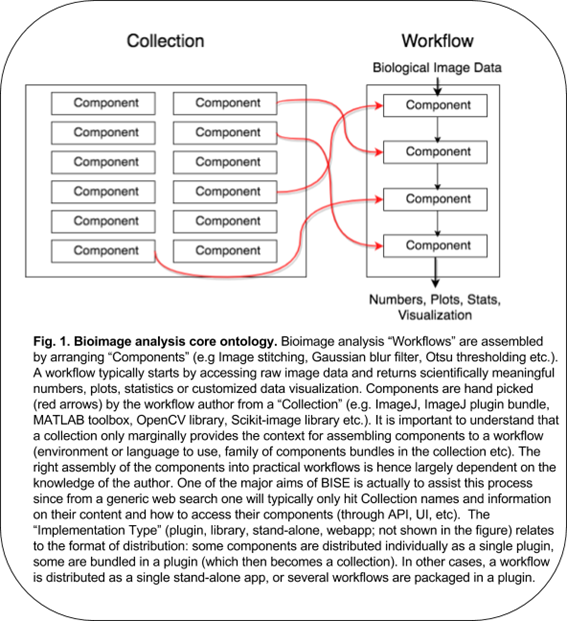
 

Many biologists feel difficulty in analyzing image data, because of the existing gap between a collection of components and a practical workflow. A collection bundles components without workflows, but it is often erroneously assumed that installing a collection is enough for solving bioimage analysis problem. The truth is that some expert has to choose components, adjust their parameters and build a workflow (Fig.1 red arrows), which is largely dependent on a priori knowledge. The correct assembly of components as an executable script is even more difficult in general, as it requires some programming skills. The use of components directly from library-type of collections, which hosts many useful components, also requires programming skills to access their API.  Bioimage analysts are then there to fill this gap but even they, who professionally analyze image data, need to always search for the best components to solve problems, reaching the required accuracy or coping with huge data in a practical time.

Another important aspect and difficulty is the reproducibility of workflows. We often want to know how other people are performing image analysis to learn new bioimage analysis strategies. We then try to find workflows addressing a similar biological problem. However, many articles do not document the workflows they used in sufficient details to reproduce the results. Some workflows are written as a detailed text description in Materials and Methods, but we recommend to publish them as executable scripts with documented parameter sets for clarity and reproducibility of analysis and results. As an extreme example, we found articles with their image analysis section in Materials and Methods merely documenting that ImageJ was used for the image analysis. Such a minimalism should be strictly avoided. For these reasons, we are promoting to publish bioimage analysis workflows in a reproducible format. The best format is a version-tracked script, i.e. a computer program because it is clear and reproducible. A script embedded in a Docker image is even better for avoiding problems associated with a difference in execution environments.

Many activities in NEUBIAS aim to address these difficulties, trying to make the process of choosing components and the construction of workflow easier, and to secure the reproducibility of published bioimage analysis workflows.

The workgroup 1 (WG1, Strategy and Scheduling) endorses the application of COST policies and moderates the strategic decisions taken in the organization of workshops and conferences. They promote communication among developers (who are implementing components and maintaining collections), bioimage analysts, microscopists and biologists, to increase the exchange of the usage information of the collections and workflows to bridge their gap (Figure 1 left and right).

The workgroup 2 (WG2, Training) aims at developing a multi-level training program in bioimage analysis based on the workflow-components concept. For beginners, basic components and their algorithms, as well as their useful assembly, are introduced. For intermediate level students, scripting languages are taught, to automate and to author reproducible workflows, and at the same time to learn practical workflows actually used in biological research projects.  For advanced level students, mainly comprised of professional bioimage analysts, advanced workflows and new components are introduced and studied in details for applications to a wider problem in biology and also to more efficiently author workflows.

The workgroup 7 (WG7, STSMs and Career Path) is organizing the extended and more individual aspect of such training, by supporting the travel of bioimage analysts and developers to other labs for implementing components and workflows in situ during missions of extended duration. WG7 is also making an effort to pave the career path of bioimage analysts, the novel type of profession in the life sciences community mediating computational science and life sciences.

The workgroup 4 (WG4, The webtool BISE) is creating a searchable database of collections, workflows and components. General web search engines, such as Google, generally return hits of collections but not to the level of components. In addition, workflows are in many cases hidden in biological papers and difficult to be discovered. For these reasons, the webtool is expected to become a useful tool for those conducting the bioimage analysis.  The webtool is also designed to note impressions on the usability of components and workflows so that individual experiences can be swiftly shared within the community.

The workgroup 5 (WG5, benchmarking) is setting up a web tool enabling the interactive testing and benchmarking of some of the workflows from BISE. From this webtool the user will be able to select some specific annotated image dataset stored in an internal database and run compatible workflows on these images. The results from the analysis will be compared to the annotations (ground truth) to compute and display some problem specific performance metrics. The user will also be able to explore the results by interactively visualizing them overlaid on the original images. Since typically many workflows are available to solve a specific bioimage analysis problem, benchmarking them in such a unified environment is instrumental for fair comparison.

The workgroup 6 (WG6, open publication) aims at publishing the NEUBIAS teaching materials based on the workflow-components concept for a wider distribution outside of the NEUBIAS community, with detailed explanation on practical workflows associated with specific biological problems, for a better and more effective bioimage analysis in the biological community.

The workgroup 3 (WG3, outreach) works on communicating the outcome of all these activities towards wider scientific community, and also to promote communication among NEUBIAS working groups.

Overall, various activities of NEUBIAS are consistently directed: They all are reaching toward a clearer procedure for choosing components and for a more efficient, explicit and reproducible authoring of workflows for biological image analysis.



NEUBIAS social media, ‘What’s in it for me?’

by Auxiliadora Sarmiento and Irene Fondon (WG3)

There is surely no better place to meet and mingle with other professionals than at our community conferences. But in this increasingly connected world, more and more of our everyday personal interactions are taking place online. Thus, social networking sites are excellent tools not only for making but also for maintaining the connections between the members of the NEUBIAS community.

Nowadays, we have an active presence on the biggest three networking sites: Twitter, Facebook and LinkedIn. You might be surprised at the effectivity of these platforms for discussing science, forging collaborations and creating supporting networks. The thrilling thing about NEUBIAS social media is that you never know who may be able to help you.

 Twitter is a great way to expand your network well beyond the lab. An engaging conversation in less of 140 characters? Yes, of course. Our tweets communicate not just news but many other valuable contents, and the possibilities are huge. You can pose a question adding @NEUBIAS_COST and the NEUBIAS community will surely respond. If you can’t attend the last conference or symposium, don’t worry, you can search our hashtag #NEUBIAS and follow it in real time. And if you have a crazy result from an experiment, why not share it?

 Facebook is the biggest social network in the world. We mostly use it for sending out news, promoting upcoming events and publishing job openings. But you can also engage in interesting conversations about advances in imaging technology, or at least eavesdrop on them. You have an audience waiting, so share a link to your latest scientific manuscript or share a technique or a tool with the group.

LinkedIn is the Facebook of the professional world. People from different backgrounds are together: life scientists, bioimage analysts (BIAlysts), microscopists, developers and more. So, why not post an update of what you are doing? You can even become a thought leader by posting interesting content or promoting our own expertise.

Now you know our social media sites, it’s time to like us on Facebook, follow us on Twitter and join our network on LinkedIn in the case you had not done it before. Your contribution is valuable for NEUBIAS!! Do not be shy 😉

Inter-COST collaboration: NEUBIAS visited CHARME

By Natasa Sladoje (WG6)

COST’s mission is to support the integration of research communities. Inter-COST collaborations strongly contribute to that.
We have recognised an opportunity to establish such a collaboration with the COST Action 15110 CHARME – Harmonising standardisation strategies to increase efficiency and competitiveness of European life-sciences research (www.cost-charme.eu).
CHARME has 30 member countries, gathered to promote comprehensive, efficient, harmonized, recognized and adopted Standard Operating Procedures in Life Sciences. Observing that currently 80-90% of the research data are not reusable or accessible, CHARME aims at:
– identifying needs, developing norms and long-term strategy, and coordinating activities of the stakeholders (researchers, industry representatives and policy makers) towards standardization of acquisition, analysis, and publication of data;
– increasing confidence in quality of data to enhance sharing and re-use;
– supporting reproducibility of data and procedures.
CHARME states that “… standards assure and ensure that data become easily accessible, sharable and comparable along the value chain. The use of common standards may hence result in improved efficiency and competitiveness of European life-sciences research.”

NEUBIAS@CHARME’s Big Data in Life Sciences
NEUBIAS was presented during a 30min long invited talk at a training school (TS) and a workshop “Big Data for Life Sciences” co-organized by CHARME and EMBnet www.embnet.org in Uppsala (Sweden) September 18-22 (http://astrocyte.com/COST-CHARME/COST-CHARME/Home.html).
The audience was composed of the TS participants (students and trainers), invited guests
and the Action leaders. Host of the event was Erik Bongcam-Rudloff, the Action vice-chair. He, together with Domenica D´Elia, the leader of CHARME’s WG for dissemination and an EMBnet representative, showed high interest for NEUBIAS and possible further collaboration.

All activities of NEUBIAS attracted attention – our great success in training and education, our engaged communication, visibility and outreach via conferences, show-case events, STSMs, and other dissemination activities, and finally our several online tools and resources supporting and promoting data accessibility and integrity, availability of methods, reproducibility of results, and cooperation in a highly multidisciplinary domain. Several attendees expressed intention to join us in Szeged, at our 2nd NEUBIAS Symposium.

NEUBIAS is warmly invited to participate at the Workshop on Standardization in Life Sciences which will be organized by CHARME in Split (Croatia), October 23-25. http://www.cost-charme.eu/events/split

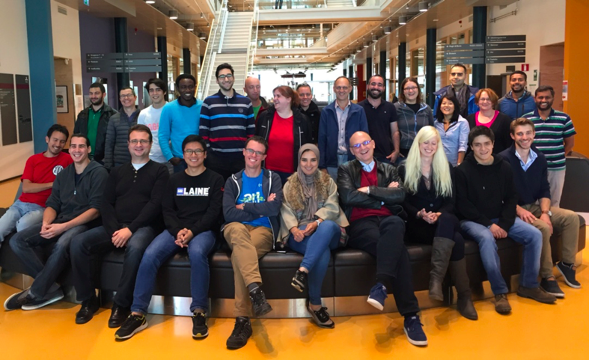
CHARME Training school on Big Data in Life Sciences attendees http://www.cost-charme.eu/news

10/13/2017

NEUBIAS Short-Term Scientific Missions

By Julia Fernandez Rodriguez and Clara Prats (WG7)

The Short-Term Scientific Missions (STSMs) grants are the best instrument NEUBIAS Action has to support ideas and knowledge exchange and collaboration among the network across borders. STSMs can vary from one week to three months. Both home and host institutions should be from a COST country which has accepted the NEUBIAS Memorandum of Understanding and has participated in the NEUBIAS Action.

Knowledge exchange – STSMs contribute to knowledge transfer to support individual careers and regional development. Alexander L. Hargreaves, from the University of Leeds UK, is one of many researchers who took part in a NEUBIAS STSM. His works involves a clinical trial investigating the effect of sperm DNA compaction faults on human fertility. Called HABSelect Clinical Trial, it’s the largest of its kind with over 3000 participants. Having only wide-field images in the Aniline Blue stain, Alexander performed a STSM in Uppsala, Sweden for one week to collaborate with image computation specialists from Prof. Carolina Wählby group. As champions of the popular open-source software CellProfiler, they have developed a range of image analysis algorithms, from shape-based thresholding and segmentation, to categorization with leading-edge deep learning architectures. “Thanks to the STSM, I appreciated learning a great deal in a short, high-pressure period of time from the very best scientists in their field. I also produced both valuable data and important future contacts for my home institution. Through NEUBIAS I feel we are forging important international links between BioImage Analysts and fertility experts across Europe. Overall, I hope that this large-scale study will act as a catalyst for improved image analysis throughout fertility science; eventually leading to better fertility outcomes for families”, says Alexander.

Cooperation and Collaboration – Enhancing further collaborations on innovative image analysis methods is also an important aspect of NEUBIAS STSMs. Victor E. A. Caldas from the Vrije Universiteit Amsterdam, performed an STSM at the laboratory of Prof. Mark Fricker, University of Oxford, UK. The specific goal of his STSM was to evaluate image datasets of symbiotic fungal networks, indicating directions for the next round of image acquisition and transfer technology of image analysis of living networks between their laboratories. “This STSM was fundamental to initiate the collaboration with Prof. Mark Fricker and to identify our common research interests and directions for future research. As a direct consequence of the STSM, Prof. Fricker will be included in my next grant application, aiming at optimizing image analysis of networks and modelling of adaptive fungal networks. I am convinced that this STSM has had a valuable and very positive effect in my research topic and career” says Victor.

NEUBIAS continues to see very positive results from these missions. Thanks to its flexible and bottom-up approach, researchers across Europe are working together to show impressive results in a short period of time!

How to Apply for a STSMs – BioImage Analysts and Life Scientists, from Research Labs AND Core facilities, can apply for funds to cover their expenses when visiting a Host-Lab in a different country (Lab or industry) where they will perform a short scientific project strictly focused on BioImage Analysis, and that should enable:
1) collaborations on innovative image analysis methods,
2) access to big data analysis technology and/or image analysis tools for scientists lacking them locally,
3) knowledge transfers to support careers and regional development.

Applications for the STSMs can be submitted any time and will be reviewed at the end of each month!

Please, check all the information here: https://eubias.org/NEUBIAS/mobility-grants/ and contact these people for any question:
Julia Fernandez Rodriguez – NEUBIAS STSM Coordinator juliafer@cci.sahlgrenska.gu.se
Clara Prats – NEUBIAS WG7 Co-Leader – cprats@sund.ku.dk
Julien Colombelli – NEUBIAS Action Chair – julien.colombelli@irbbarcelona.org